

Recommended Information
Zhang Xiachang, the "father of paper batteries": Electronic technology brings innovation to traditional printing
Publish Time
2016/11/24
On May 16, 2013, at the "First China Functional Materials Printing Technology Development Forum," held on the third day of the eighth Beijing International Printing Technology Exhibition, thin-film printed paper battery technology was introduced. It is understood that the end products of thin-film printed paper battery technology include active or semi-active RFID electronic tags, tag sensors, smart cards and smart packaging, medical electronic drug patches, and cosmetics. A reporter from China Printing and Packaging Network had the opportunity to interview Dr. Zhang Xiacang. Let's get closer to him and learn more about the applications and development space of "paper batteries"!

Image above: Dr. Zhang Xiacang, a Chinese scientist
What is a paper battery?
A paper battery is a battery that uses paper as a carrier. Researchers apply special ink made of silver and carbon nanomaterials to paper to create a "paper battery," bringing hope to lightweight and efficient new energy storage. Dr. Zhang Xiacang, a Chinese scientist, is the main developer of this paper battery. According to him, this battery is used as a power source for smart cards, musical greeting cards, and e-newspapers, and can be used in RFID (radio frequency identification) electronic tags. With the rapid development of RFID technology, the potential market for this paper battery is expected to reach billions of dollars in the future.
A paper battery is actually a power source. For example, this RFID tag with a paper battery I'm holding is actually an RFID temperature sensor tag. You can see that it has three parts: a battery, a chip, and an antenna. The chip contains a temperature sensor. What are its main applications? First, it can be placed on the human body to measure body temperature. Many diseases require this detection, especially for patients at home. 24-hour temperature monitoring is possible. In addition, there are many food and drug safety issues in society. How are they caused? Many people know that in addition to problems with the production units, there are also many problems in the circulation links. For example, some products need to be refrigerated and are not suitable for high temperatures. As a result, products that should be refrigerated are not, such as milk, which should not exceed a certain temperature or it will spoil. If it's kept in the refrigerator, it can last for several days. This product allows the label to achieve full traceability throughout the process." said Dr. Zhang Xiacang.
For example, this is a medicine. After applying this label, it has an ID from the day it was produced, and its surrounding temperature is recorded. When the temperature rises, the product may spoil. Different products have different temperature requirements. During transportation, you can read the label to see if the temperature has exceeded the limit. This can be applied to any product that needs refrigeration or preservation, such as vegetable transportation." Dr. Zhang Xiacang said while demonstrating the sample tag. Unlike drug regulatory codes, which are non-dynamic and only show the product's origin, they cannot record temperature changes. The tag with a paper battery makes this process dynamic. It has a globally unique code, equivalent to an RFID ID, and this number is globally unique, which is the number on the chip.
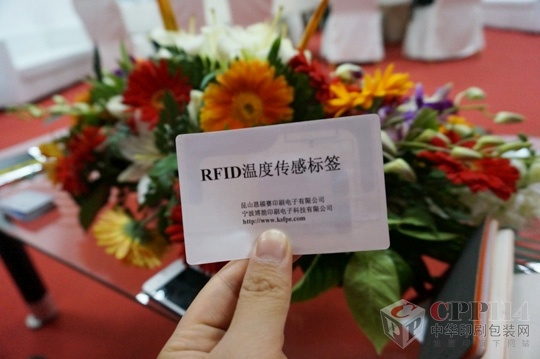
Image above: RFID temperature sensor tag provided by Dr. Zhang Xiacang
This product was recently developed. In addition to the patented paper battery technology, the core is the chip with a sensor. Although there was chip technology before, the conditions were not perfect at the time. Now, with the popularization of the Internet of Things, this product has a wider range of uses. In other words, in the past we pursued product quality at the time of manufacture, now we pursue full-cycle quality monitoring, including production, inventory, logistics, and other circulation areas. No matter where the product ends up, after applying this label, it can completely record every stage of the product's journey, especially providing an effective life cycle for pharmaceuticals." said Dr. Zhang Xiacang.
For example, if a certain medicine has this kind of label, the doctor is the final reader, and he only needs a reader to determine if the medicine is qualified; if it is a private user, he can also check it through the RFID reader in his mobile phone. In addition, Dr. Zhang Xiacang also talked about another possibility: "We can also set up a display screen on it. The end user only needs to press the power button, and the relevant information can be read on this display screen, and it can also be seen at a glance whether the product is qualified.
The sensor tag, temperature is just one application area, it can also be transformed into a heartbeat sensor. There is also a BIP tag, a tag without a sensor, which is much stronger than a traditional passive tag, but weaker than an active tag, but the price is very moderate, such as weapon management, book management, asset management, etc.
Currently, Mr. Zhang Xiacang has factories in Kunshan and Ningbo, and is currently in the process of building paper battery production lines. The end products are still under development, but some samples have been produced for market promotion.
As a new concept battery, the new paper battery can only be positioned as an exploratory research invention. Due to process and other reasons, it cannot replace other widely used types of batteries, nor can it occupy the market in a short period of time. It is an ideal driving device for laptop computers, mobile phones, digital cameras, and even automobiles. Because of its strong plasticity, this battery can even be made into the shape of a car door, and it has unparalleled advantages over other batteries in driving miniature medical devices (such as pacemakers). Looking back at the printing industry, its market prospects are still considerable, and it may be a groundbreaking innovation, because the development of printed electronics has given the traditional printing industry greater opportunities. The current technology of the traditional printing industry is difficult to break through, but the development of printed electronics can promote its development, so the development of the two is complementary. Environmental protection, low power consumption, low price, and high value are the characteristics of the printed electronics industry.
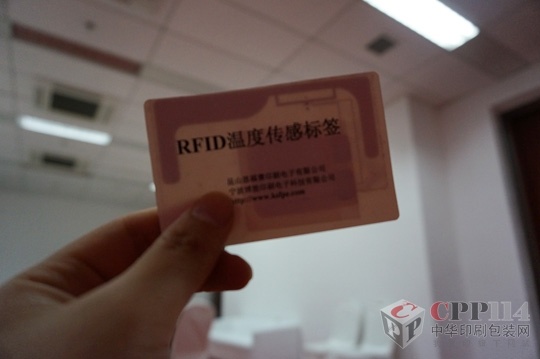
Image above: The three major components—paper battery, chip, and antenna—are clearly visible.
After leaving Finland and resolutely choosing to return to China to start a business, Dr. Zhang Xiacang frankly stated that the primary reason is that he is Chinese. He said: "Mainly because the paper battery is the most important space for the future development of the printed electronics industry. As a Chinese, returning to China to start a business is also a very natural thing. There aren't many reasons, it just happened naturally."
According to statistics, in 2011, the global total output value of the printed electronics industry reached US$2.4 billion, and by 2021, the total output value of the printed electronics industry may reach US$100 billion, which shows that the prospects of the printed electronics market are very broad. China is a major consumer and producer of electronic products, and also a major printing country. Dr. Zhang Xiacang and his paper battery technology also face huge market opportunities and space. Currently, paper battery products have been successfully developed, the only thing lacking is the promotion of their uses.
Many people may wonder, how long can such a battery last? Dr. Zhang Xiacang answered: "The lifespan of a paper battery depends on power consumption. Generally speaking, its shelf life is more than three years. Because the power consumption is too low, the refrigeration power of the paper battery is too small. At normal low temperatures of -18°C to -22°C, research shows that at a voltage of 2V, this new type of paper battery can generate 10 mA of current per gram. It is introduced that this new type of battery, in addition to its innovative manufacturing method, also has many important characteristics, such as flexibility. Because the main component of this new type of paper battery is cellulose, it retains some of the characteristics of paper and has good flexibility. According to experiments, this battery has a strong adaptability to temperature and can be used normally in the temperature range of -45°C to 80°C."
Facing the new market, it is somewhat difficult to develop, but once this market is opened, it will be very large. Dr. Zhang Xiacang is very confident about this, for two reasons: First, the battery technology, because this battery is internationally leading, it was invented by him, and the honor of "Father of Paper Battery" was widely spread by European and American media before it was reported by domestic media; second, the chip is also the best overseas chip, which itself represents the most advanced international level.
keywords
Hotline:
Beijing time: 15:00~21:00 Finland time: 10:00~16:00
Tel:+8613482000307
Email:info@enfucell.com
Address: Länsituuli 1,02100 Espoo,Finland
Website:www.enfucell.com


Copyright © 2025 Jiangsu Enfu Sai Flexible Electronics Co., Ltd. www.300.cn Tags
Copyright © 2025 Jiangsu Enfu Sai Flexible Electronics Co., Ltd.